
The Psychology of Habits

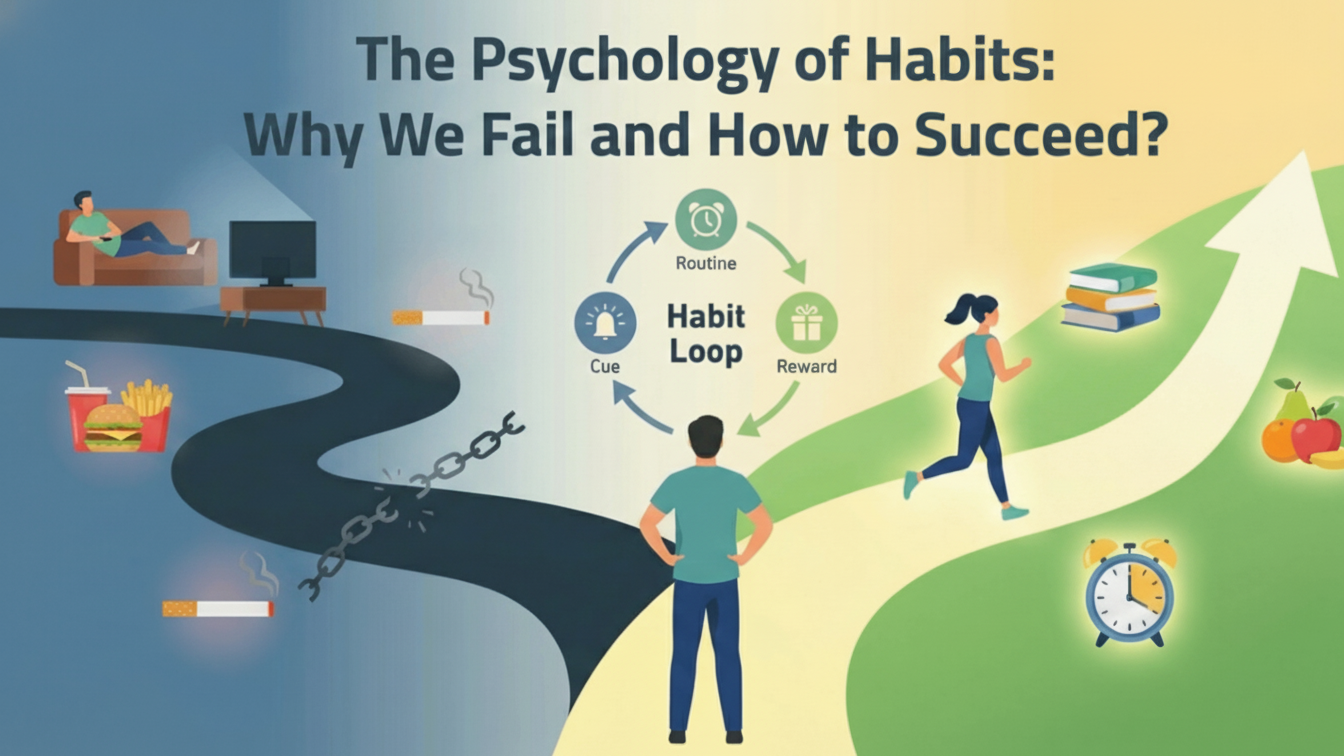
Why We Fail to Change and How to Succeed This Time?
How many times have you promised yourself to start a healthy diet, read a book every month, or wake up early, only to find yourself back to square one after just two weeks?
This recurring scenario is not proof of a weak personality or a lack of determination. Rather, it is a result of not understanding the “language of the brain.” Change is not just an emotional decision; it is a complex biological and psychological process. In this article, we will dive deep into the psychology of habits to understand why we fail, and how to use science to our advantage this time.
First: How Does a Habit Work? (The Habit Loop)
To understand how to change, we must first understand what a habit is made of. A habit is a mechanism the brain uses to save energy, turning repetitive behaviors into “autopilot mode.” Any habit consists of three main parts called the “Habit Loop”:
- The Cue: The trigger that tells your brain to start the habit (e.g., phone ringing, feeling bored, or the smell of coffee).
- The Routine: The behavior itself, whether physical or mental (e.g., scrolling through Facebook, lighting a cigarette, or biting your nails).
- The Reward: The prize your brain receives that encourages it to remember this behavior in the future (e.g., a temporary feeling of relief, pleasure, or the disappearance of anxiety).
Why Do We Fail to Change? (Common Mistakes)
Failure is often the result of following wrong strategies that contradict human nature. The most prominent include:
- Relying on Willpower Alone: Willpower is like a “muscle” that gets fatigued with overuse during the day. Relying on it alone is a losing battle.
- Trying to Change Everything at Once: Over-enthusiasm drives us to completely overhaul our lives in one day. This causes shock to the brain, pushing it to resist and return to the familiar old ways.
- Focusing on the Goal, Not the System: We focus on “losing 10 kg” (the goal) instead of focusing on “walking for 20 minutes daily” (the system).
How Do We Succeed This Time? (Psychological Strategies)
Based on our understanding of the habit loop, here are 3 practical steps to build habits that last:
1. Don’t Rely on Your Memory, Design Your Environment
The golden rule in behavioral psychology says: Make the good habit easy, and the bad habit hard.
- Want to read before bed? Place the book on your pillow in the morning.
- Want to reduce phone scrolling? Don’t keep it next to you while working; make accessing it require effort. You are thus controlling the “Cue” that triggers the habit.
2. Start Very Small (The Two-Minute Rule)
The biggest obstacle to any new habit is “starting.” To break the barrier of laziness, make the new habit take less than two minutes.
- Instead of “I will run 5 km,” say “I will just put on my running shoes.”
- Instead of “I will read a whole chapter,” say “I will read one page.” Once you start, continuing becomes much easier. The goal here is to establish the “habit of showing up” before improving performance.
3. Replace the Routine, Don’t Delete It
It is very difficult to delete a bad habit by simply banning it, because the brain still craves the “Reward.” The solution is to keep the Cue and Reward, but change the Routine.
- Example: If you feel stressed (Cue) and eat sweets (Old Routine) to feel relief (Reward), try replacing eating with a brisk walk or calling a friend (New Routine) when you feel stressed.
Conclusion
Building habits is not a sprint; it is a long marathon. Do not beat yourself up if you stumble one day. True change is the result of simple, consistent repetition, not dramatic, sudden transformations. Always remember: Consistency beats intensity.