
The Overthinking Trap

How to Silence the Mental Noise and Reclaim Your Calm
Have you ever lain in bed at 2 AM, your body screaming for rest, but your mind is in frenzied activity replaying the day’s tape? “Why did I say that sentence?”, “Did the manager mean to insult me?”, “What if I fail the upcoming project?”.
If this scenario is familiar, you are not alone. You are stuck in what psychologists call “rumination” or Overthinking. It is not just “deep thinking”; it is mental noise that drains your energy and deprives you of enjoying the present.
In this article, we will deconstruct this trap to learn how to escape it.
Are You Thinking or “Overthinking”? (The Crucial Difference)
It is natural to worry or plan for the future, but there is a fine line separating “healthy thinking” from “overthinking”:
- Healthy Thinking (Problem Solving): Focuses on the Solution. It asks questions starting with “How?” (How do I fix this mistake?). It ends with a clear action plan and makes you feel better.
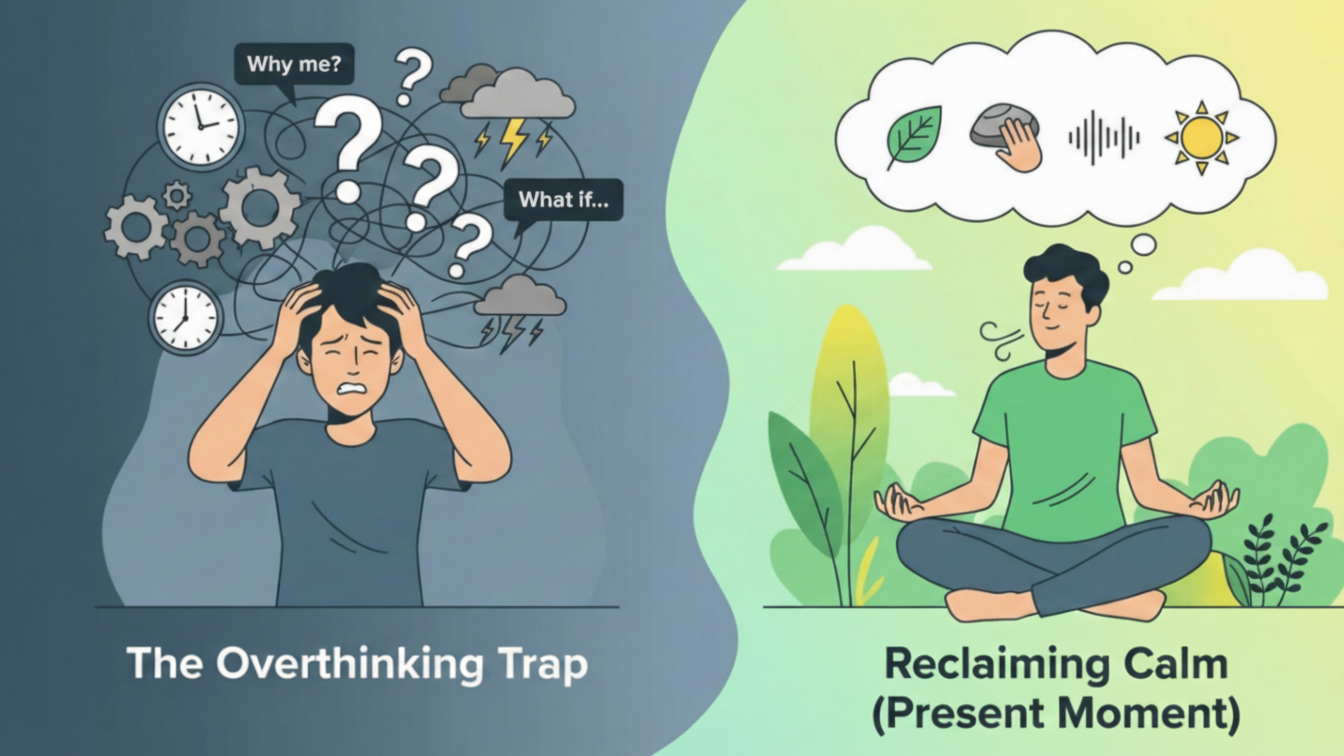
- Overthinking (Rumination): Focuses on the Problem. It asks questions starting with “Why?” and “What if?” (Why is this happening to me? What if a disaster occurs?). It spins in an endless vicious cycle that leads to no action and makes you feel helpless.
Simply put: Healthy thinking is a map leading you to a destination; overthinking is a roundabout you circle endlessly.
Why Do We Fall into the Trap? (The Illusion of Control)
Our minds are programmed to protect us, so they tend to focus on negatives to avoid danger. Overthinking is a desperate attempt by the brain to feel “in control” of the unknown. We falsely believe that the more we worry, the more prepared we are for the future. But the truth is, worry does not prevent tomorrow’s disasters; it only steals today’s peace.
4 Practical Techniques to Stop the Mental Noise
The good news is that overthinking is an acquired “habit” that can be replaced. Here is how to press the “pause button” on your mind:
1. The “Label the Thought” Technique
When thoughts begin to attack, do not argue with them. Instead, acknowledge their presence and label them. Say to yourself: “I am currently having a moment of overthinking” or “This is just worry, not fact.” This simple act separates you from the thought; you are not your thoughts, you are their observer.
2. Schedule “Worry Time”
Instead of letting anxiety ruin your entire day, assign it a specific time slot (e.g., 20 minutes daily at 5 PM).
- If a worrying thought comes at noon, tell it: “Not now, our appointment is at five.”
- When the time comes, sit down and worry as much as you want, or write down your fears.
- Over time, you will discover that most worries fade before their appointment arrives.
3. Activate Your Senses (The 5-4-3-2-1 Technique)
Overthinking takes you to the future or the past. The solution is to return to the “here and now.” Use your senses to anchor yourself in the moment:
- Notice 5 things you see around you.
- Touch 4 things with your hand.
- Listen to 3 sounds.
- Smell 2 scents.
- Taste 1 thing (or notice the taste in your mouth). This forces the brain to get out of the “head” and back into the “body.”
4. Turn “What If?” into “What Will I Do?”
The biggest fear for overthinkers is helplessness.
- Instead of: “What if I get fired from my job?” (A dead end).
- Say: “If I get fired, I will update my resume, and I have savings enough for two months.” Turning fear into a plan kills the monster you created in your imagination.
Final Word
Your mind is a wonderful tool for calculation, analysis, and creativity, but it is a cruel master if left to steer the ship without direction. Do not try to silence your mind completely, as that is impossible, but learn how to turn down the volume of the noise so you can hear the sound of life around you once again.