
Neuroplasticity: Your Lifelong Brain Architect

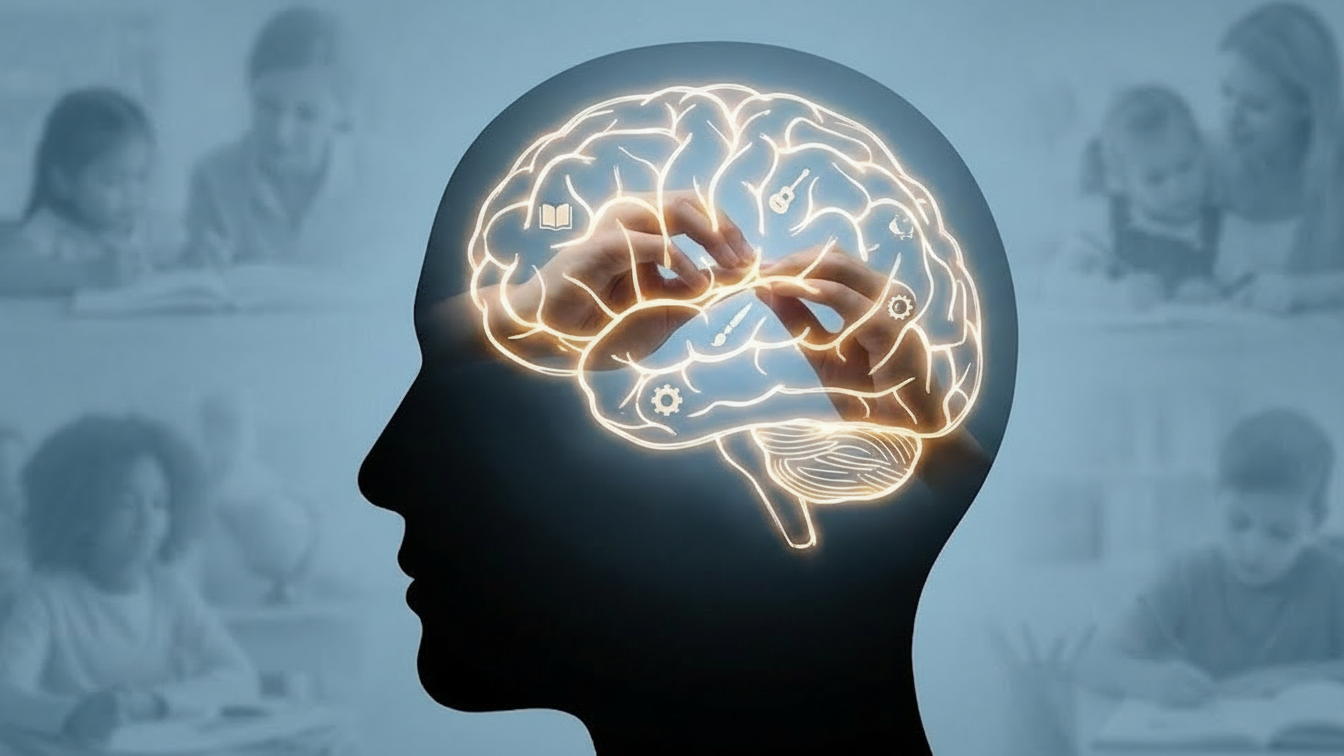
How to Redesign Your Mind and Acquire Super Skills at Any Age
For years, we grew up believing an old scientific myth: “The brain stops developing after puberty, and the nerve cells you lose are gone forever.” This idea was discouraging for many, implying that our mental capacities and talents were “predetermined” and set in stone.
However, modern science has brought revolutionary good news: Your brain is not a fixed machine; it is a muscle capable of being shaped and developed until the very last day of your life. This is what is scientifically known as “Neuroplasticity.”
What is Neuroplasticity?
Simply put, neuroplasticity is the brain’s ability to reorganize itself by forming new neural connections throughout life.
Imagine your brain as a vast network of roads. Every time you think in a certain way or practice a specific skill, you are paving a new road. With repetition, this small dirt path turns into a paved, easy-to-traverse highway (the skill becomes a habit). Conversely, the roads you stop using (old habits or neglected skills) atrophy and disappear.
How Does This Mechanism Work? Hebb’s Golden Rule
Psychologist Donald Hebb summarized the mechanism of neuroplasticity in a famous phrase:
“Neurons that fire together, wire together.”
When you try to learn something new (like playing the piano), your brain cells send electrical signals to one another. Initially, the connection is weak and difficult (which is why learning feels hard at first). But with constant practice, these connections strengthen, the signal becomes faster and more efficient, and the physical structure of your brain actually changes to accommodate the new skill.
How Can You Use Neuroplasticity to Your Advantage?
The good news is that you are not just a spectator; you are the engineer who can direct this construction process. Here are 5 practical ways to reshape your brain:
1. Step Out of Your Comfort Zone (Novelty) The brain loves routine because it saves energy, but routine is the enemy of neuroplasticity. To stimulate your brain, you must expose it to new experiences.
-
- Practical Application: Take a new route to work, use your non-dominant hand to brush your teeth, or learn an entirely new language. Challenge is the fuel that builds new neural pathways.
2. Intense Focus and Deliberate Practice Repetition alone is not enough; it must be focused repetition. Neuroplasticity occurs when you are fully attentive to what you are doing.
-
- Practical Application: Dedicate 20 minutes daily to learning a skill with complete focus (no phones or distractions). Quality is far more important than quantity here.
3. Physical Exercise (Brain Fertilizer) Exercise doesn’t just build muscles; it pumps blood and oxygen to the brain and stimulates the release of a protein called BDNF. This protein acts as “fertilizer,” helping new nerve cells grow and survive.
-
- Practical Application: Brisk walking for 30 minutes a day is sufficient to trigger this process.
4. Quality Sleep: Construction Time During the day, you gather information, but during sleep, the brain processes this information, integrates it into long-term memory, and builds neural connections. Lack of sleep prevents cementing what you have learned.
-
- Practical Application: Ensure continuous sleep (7-8 hours) to guarantee the brain’s “cleaning and building” process occurs.
5. Mental Visualization Studies have proven that the brain doesn’t differentiate much between performing a real action and imagining it very vividly. Imagining yourself practicing a skill successfully activates the same brain regions that activate during actual practice.
Conclusion: You Are Not a Prisoner of Your Genes
The concept of neuroplasticity gives us the “power of hope.” Whether you want to get rid of anxiety, learn a new skill at sixty, or recover from an old injury, your brain is biologically equipped to help you do so.
It doesn’t require magic, but rather repetition, patience, and constant challenge. Always remember: Your mind is not a stone statue; it is clay in your hands… How will you shape it today?