
Your Digital Wellbeing

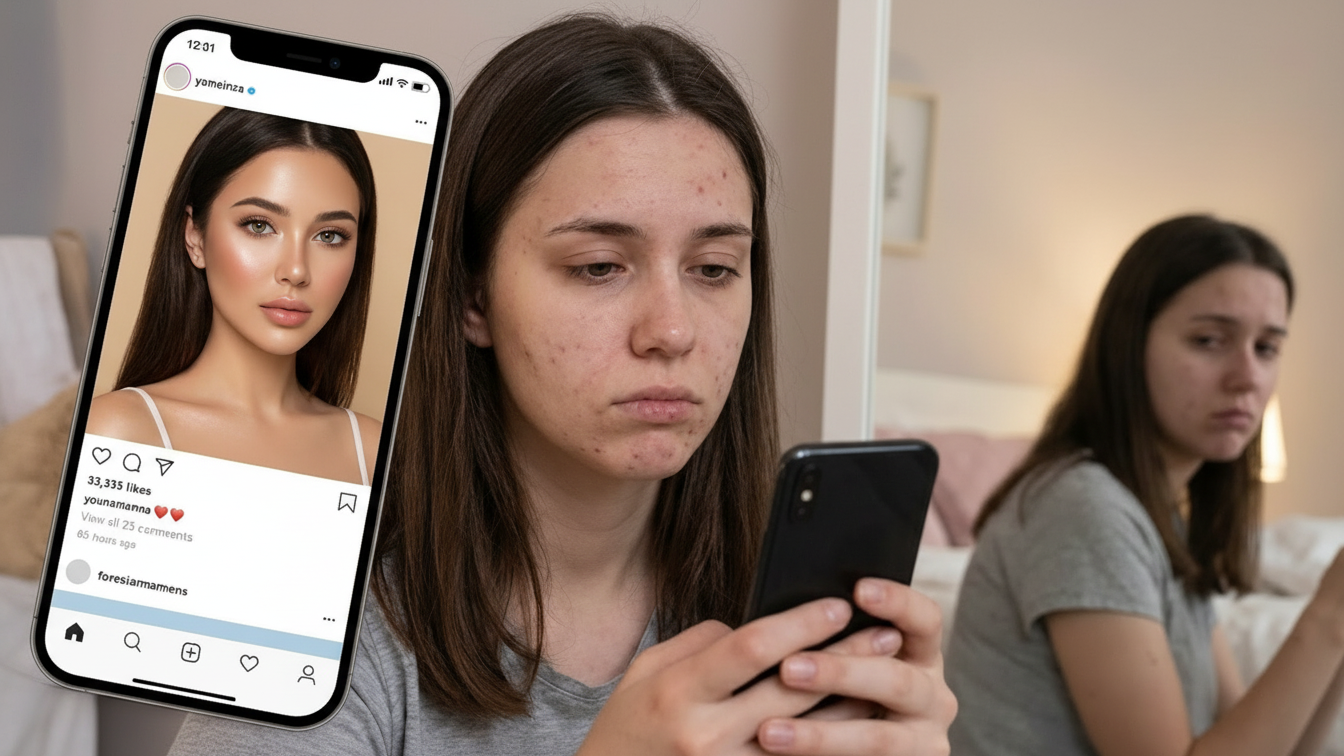
Between the “Impossible Beauty” Trap and Hacking Your Brain Chemistry
Discussing the dangers of social media is no longer just older generations “complaining” or passing warnings. As we stand in 2025, these warnings have turned into irrefutable scientific facts supported by massive data.
Recent “Digital Wellbeing” reports haven’t just come to tell us we spend too much time in front of screens; they have arrived to explain how these platforms are reshaping our brains and our self-perception in ways far more dangerous than we imagined.
In this article, we review the two most dangerous fronts revealed by recent studies in our daily psychological war with algorithms.
Front One: The False “AI” Mirror and Body Image Dysmorphia
Perhaps the most terrifying shift in the last few years is the transition of “filters” from mere entertainment tools adding bunny ears, to hyper-realistic beauty tools powered by Artificial Intelligence.
Recent reports indicate a worrying exacerbation of eating disorders and body image anxiety, specifically among “Gen Z” females. The problem is no longer just comparing oneself to celebrities, but comparing oneself to a “digitally enhanced” version of oneself that is impossible to achieve in reality.
- Superhuman Standards: AI filters promote aesthetic standards (poreless skin, geometrically sculpted features) that do not exist in human biology.
- Reality Shock: When a girl looks in the real mirror after hours of seeing herself through a filter, she experiences something akin to “shock.” This generates a deep sense of inadequacy and self-hatred, which is primary fuel for disorders like anorexia or bulimia.
Front Two: Not Just Addiction… It’s “Hacking” Your Brain’s Reward System
Previously, we spoke of “Internet addiction” in general terms. Today, science puts its finger precisely on the wound: Platforms don’t want you to enjoy yourself; they want you to remain in a state of “constant anticipation.”
Research focus has shifted to understanding how algorithms manipulate the “Dopamine Loop.” Dopamine isn’t the “happiness hormone” as commonly rumored; it is the hormone of “desire and seeking more.”
- The Slot Machine Effect: The “pull-to-refresh” (Infinite Scroll) feature was designed to work exactly like a slot machine. You don’t know when you’ll get the next “reward” (a funny post, shocking news, a new like). This “uncertainty” keeps the dopamine system on maximum alert, rendering you unable to stop.
- The Psychological Tax: This constant manipulation places the brain in a state of chronic alertness, leading to two catastrophic results we clearly see today:
- Severe Attention Deficit: Difficulty focusing on any long-term task (like reading a book).
- Chronic Anxiety: A constant feeling of unease and the fear of missing out (FOMO).
The Takeaway: Awareness is the First Step to Regaining Control
The reports of 2025 are not a call to abandon technology, but a warning bell that we are dealing with tools psychologically designed to exploit our biological weaknesses. The awareness that the image is “AI-fabricated,” and that the urgent desire to scroll is a “chemical trick,” is the first line of defense to protect our mental health in this savage digital age.