
When Silence Speaks:

How Technology Turned “Mind Reading” from Sci-Fi to Therapeutic Reality
Do you remember those sci-fi movies where heroes move objects with their minds or communicate without uttering a single word? Well, it seems the future has arrived faster than we expected.
The years 2024 and 2025 did not pass quietly in the world of Neuropsychology. We have witnessed quantum leaps that turned yesterday’s impossibilities into today’s daily news. We are not talking about magic, but about the revolution of “Brain-Computer Interfaces” and new brain mapping.
In this article, we dive into your mind to see how science is rewriting what we know about being human.
1. Brain-Computer Interfaces (BCI): The End of the “Body Prison”
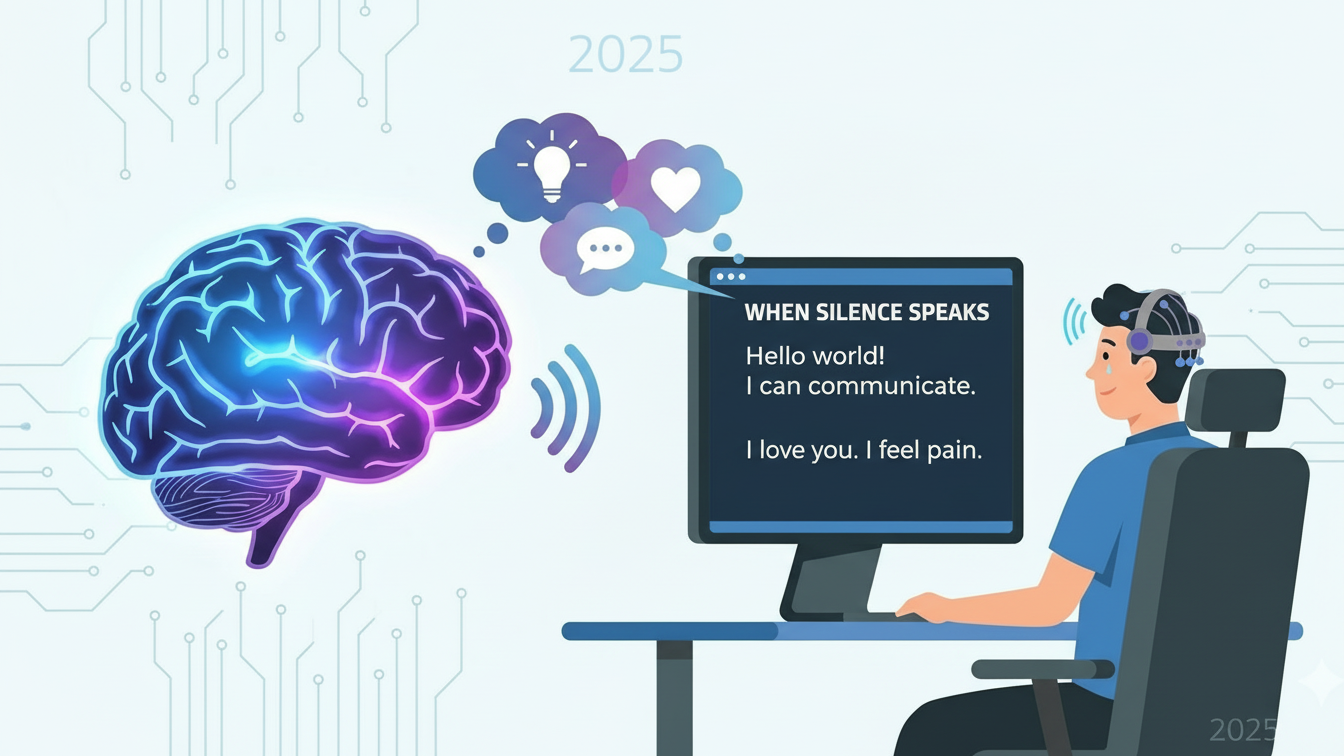
Perhaps the most headline-grabbing breakthrough is the unprecedented success in developing Brain-Computer Interfaces (BCI). Imagine a patient with complete paralysis; their mind is working perfectly, but their body refuses to respond, leaving them unable to say “I love you” or “I am in pain.”
What has changed? Modern technologies are now able to capture the minute electrical signals the brain sends when a person “thinks” about speaking. Artificial Intelligence algorithms “decode” these signals and instantly convert them into written text or audible speech with amazing accuracy and speed approaching natural conversation.
- Psychological Impact: This is not just a technical achievement; it is the restoration of a “voice” to those who lost it, and a reclaiming of human identity after years of forced silence.
- Linguistic Discovery: This technology has helped scientists understand “how the brain constructs language” much more deeply than we previously knew.
2. “Google Maps” for the Human Mind: Maps Revealing the Hidden
For years, we viewed the brain like an old paper map; we knew the main regions, but we ignored the fine details. Today, high-resolution maps of the human brain have been published, akin to upgrading from a paper map to a sophisticated GPS system.
Why is this important? These new maps allow us to see neural pathways with extreme precision, opening the door to understanding complex neuropsychiatric diseases that have baffled scientists for decades, such as Schizophrenia.
- Instead of treating Schizophrenia merely as a “chemical mystery,” these maps have started to reveal “micro-faults” in the brain’s connectivity network that lead to hallucinations and delusions.
- This means we are approaching treatments targeted with “surgical” precision at the damaged pathways, rather than drugs that affect the entire brain.
The Takeaway: Technology Serving Humanity
Neuropsychology today is no longer limited to theoretically studying behaviors and their relationship to the brain. It now possesses the tools to “repair” broken pathways and “translate” silent thoughts. We are living in an era where the barrier between biology and technology is dissolving—not to copy our minds, but to give a better life to those whose bodies have failed them.