
Is Your Next Therapist a Robot?

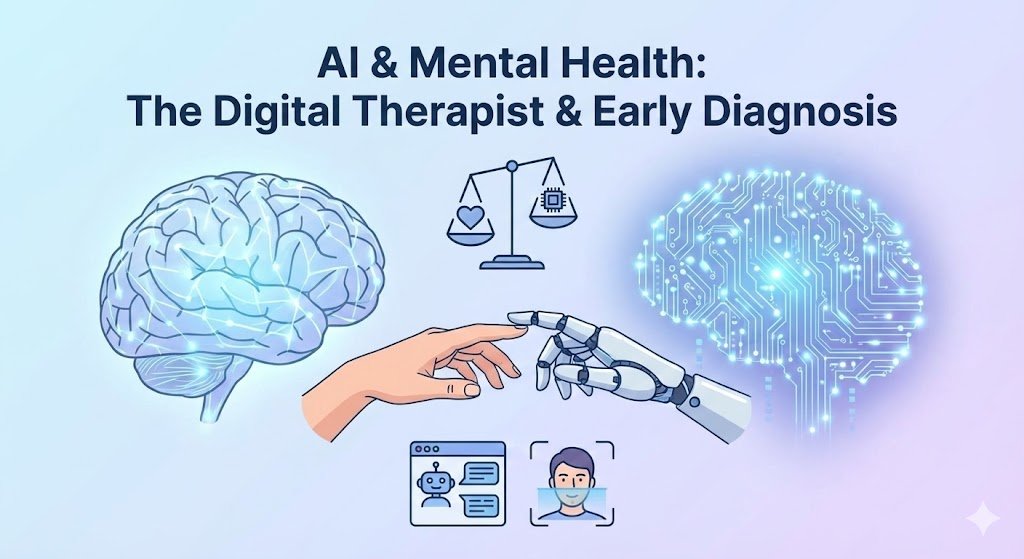
The AI Revolution in Mental Health
When we hear the term “Artificial Intelligence,” images of industrial robots, self-driving cars, or text-generating tools often spring to mind. But have you ever imagined that this digital intelligence could be the hand reaching out to pull you from a bout of depression, or the eye that spots signs of anxiety in you before you even realize them yourself?
We are living through a historic paradigm shift today; AI is no longer just a cold research tool, but has transformed into a promising “therapeutic assistant,” redrawing the map of psychiatry as we know it.
In this article, we explore how technology is changing our mental health through two main avenues: The Digital Therapist and Superhuman Diagnosis.
1. The Digital Therapist: Goodbye to Stigma and High Costs?
Visiting a therapist has long been hindered by two major barriers: high costs and social stigma (shame). This is where “Therapeutic Chatbots” come into play.
These are not just automated reply software; they are advanced systems trained in “Cognitive Behavioral Therapy” (CBT) techniques. They listen to you, analyze your emotions, and provide immediate support and relaxation exercises at any time of the day.
- Why do people turn to them? Because a robot doesn’t judge. You can tell it your deepest secrets at 3:00 AM without feeling the embarrassment you might feel in front of a human.
- Is it a complete substitute? They are still in the “initial support” or “psychological first aid” stage, but they serve as a vital bridge for those who cannot access a human therapist.
2. Early Diagnosis: When the Machine Sees What Humans Miss
This is the most exciting (and perhaps terrifying) aspect of the topic. Humans are skilled at hiding their feelings; a depressed person might smile in your face, and you’d say they are “fine.” But AI cannot be easily deceived.
Companies have developed precise algorithms that act as “psychological radars” to detect subtle indicators:
- Tone of Voice: AI can analyze “micro-tremors” or changes in speech patterns that characterize Alzheimer’s or depression patients years before obvious symptoms appear.
- Facial Expressions: Smart cameras analyze “micro-expressions” that appear and disappear in fractions of a second, revealing sadness or anxiety that the naked eye misses.
- Writing Footprint: How you write posts on Facebook or Twitter, the words you choose, and even your typing speed are all data points used to predict mental health relapses with accuracy that sometimes exceeds traditional human observation.
The Takeaway: Collaboration, Not Replacement
Will the “robot” replace the “doctor”? The short answer is: No. Psychiatry, at its core, relies on “human empathy” and warmth that algorithms cannot simulate (yet). However, the future holds a “hybrid” model: AI performs screening, diagnosis, and precise analysis, while a human therapist uses this data to provide a treatment plan filled with compassion and understanding.
Technology is not here to take the place of humans, but to make us understand ourselves deeper and faster than ever before.