
The “I See It Everywhere” Phenomenon

Why Things Suddenly Appear Everywhere After You Discover Them
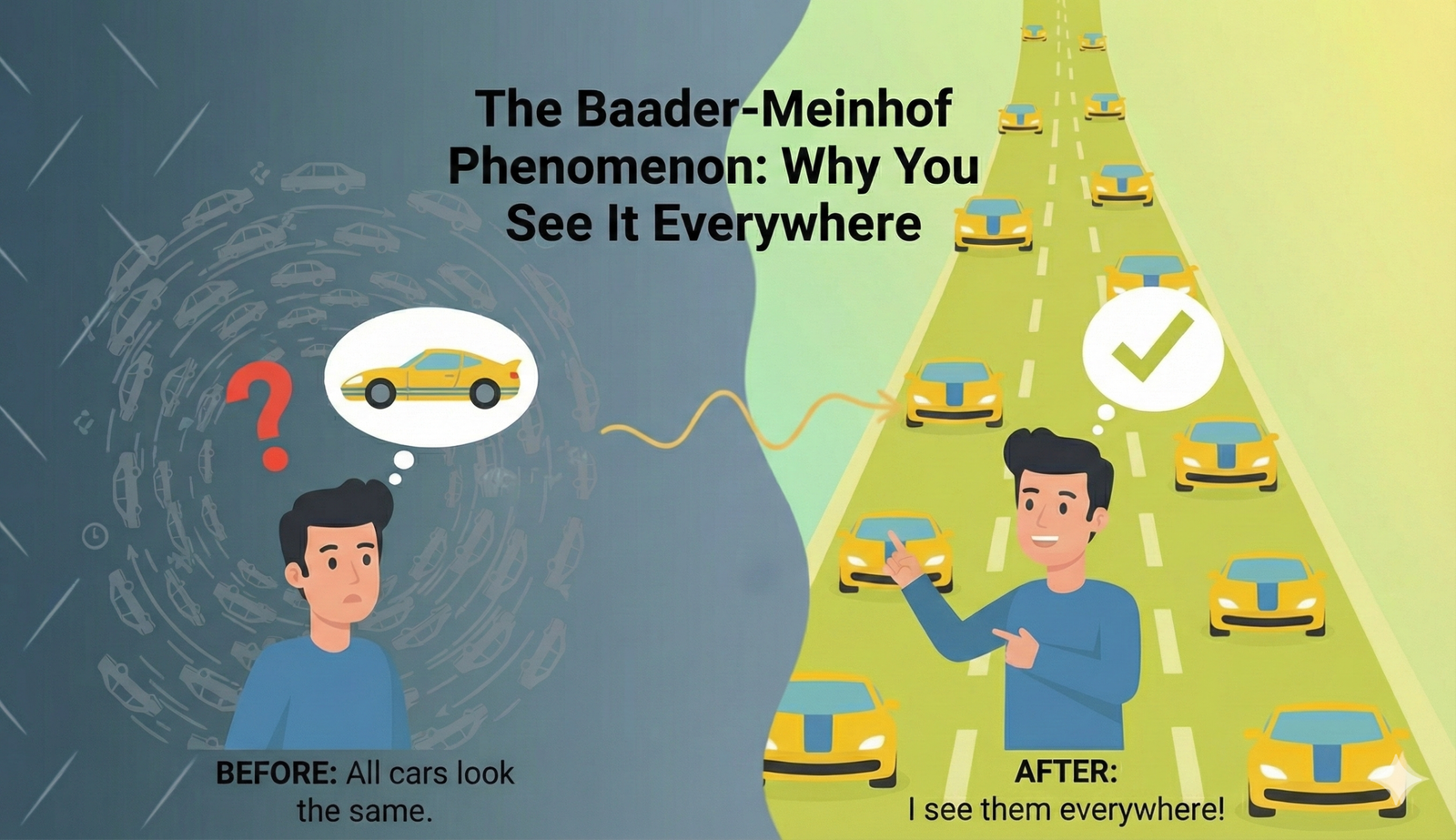
Imagine this scenario: You’ve finally decided to buy a new car, let’s say a specific model in “sky blue.” You thought this color was unique and rare. But, as soon as you drive off the lot, you start noticing something strange: the streets are suddenly filled with sky-blue cars!
Or perhaps you learned a new, strange word in the morning, only to be surprised that you heard it on the radio, read it in an article, and heard a friend use it that very same evening.
Is the world conspiring to suddenly show us these things? Or did everyone just decide to buy that car on the same day as you?
The answer lies in an amazing mental trick called the “Baader-Meinhof Phenomenon,” or its more accurate scientific name: the “Frequency Illusion.”
In this article, we will decode this phenomenon to understand how our mind decides what we should see and what we should ignore.
What Is This Phenomenon, Simply Put?
In short, it is the feeling that something (a word, a car, an idea, a person’s name) has suddenly started repeating and appearing everywhere at a very high rate, right after you first learned about it or paid attention to it.
The truth is, the frequency of this thing hasn’t actually increased in reality; the blue cars were always on the street in the same numbers. What changed are your mind’s “radars.”
How Does the Trick Work? (The Psychological Mechanism)
This phenomenon is the result of an interesting collaboration between two psychological mechanisms in your brain:
1. Selective Attention
Every second, your brain is exposed to a flood of information (sounds, colors, faces, signs). If you paid attention to everything, you’d go mad. Therefore, your brain acts as a powerful “filter,” ignoring 99% of the noise and focusing only on what matters to you.
When you bought the new car, your brain placed an “important” tag on this model and color. Suddenly, the filter stopped ignoring those cars and started “picking them out” from the crowd and highlighting them. You aren’t seeing more of them; you just stopped ignoring them.
2. Confirmation Bias
Once your brain starts noticing the thing, “confirmation bias” kicks in. Your brain loves to prove its new ideas right. Every time you see that car, your brain tells you: “See? I told you they are very common!” It actively looks for evidence to confirm your new observation and ignores hundreds of other cars with different colors.
Why Does This Happen?
This is not a flaw in your brain; it is an evolutionary advantage. Our minds are designed to recognize patterns. In ancient times, if you learned the shape of a “poisonous plant” or the “track of a predator,” it was essential for your survival to start seeing this pattern everywhere to avoid danger.
Today, your brain uses the same old mechanism to show you cars, or make you suddenly notice pregnant women everywhere once you start thinking about pregnancy!
The Takeaway: We See What We Care About
The “Baader-Meinhof” phenomenon is a humbling reminder that we do not see the world exactly “as it is” objectively. We see the world through the lens of our current interests, fears, and the things we have just learned.
Next time you feel the universe is sending you repeated signals about something, smile and remember: The universe hasn’t changed; it’s just that the “filtering system” in your head got a new update.